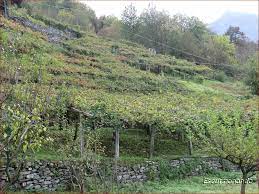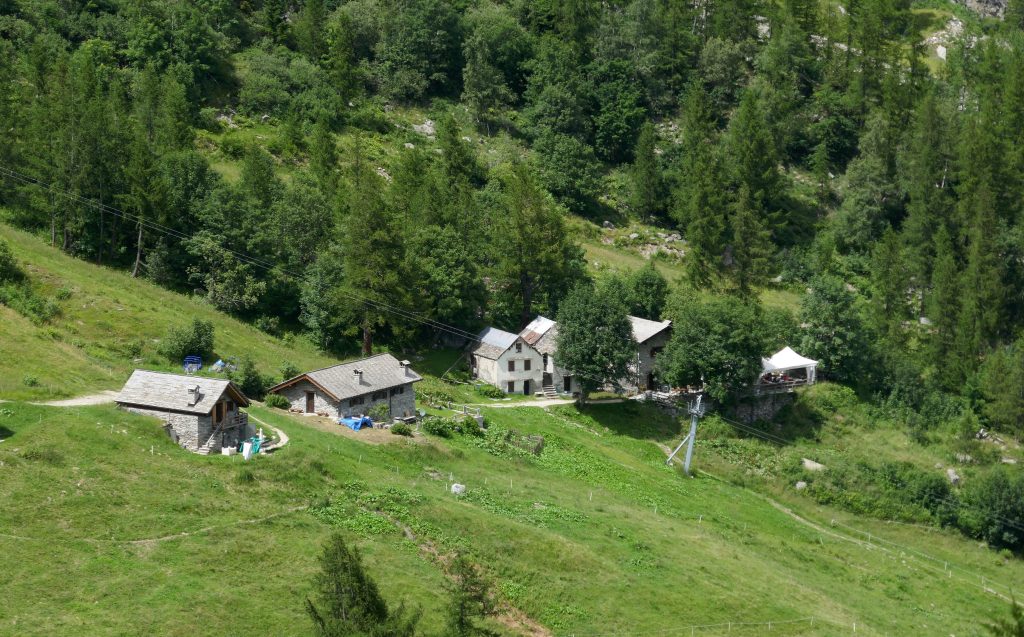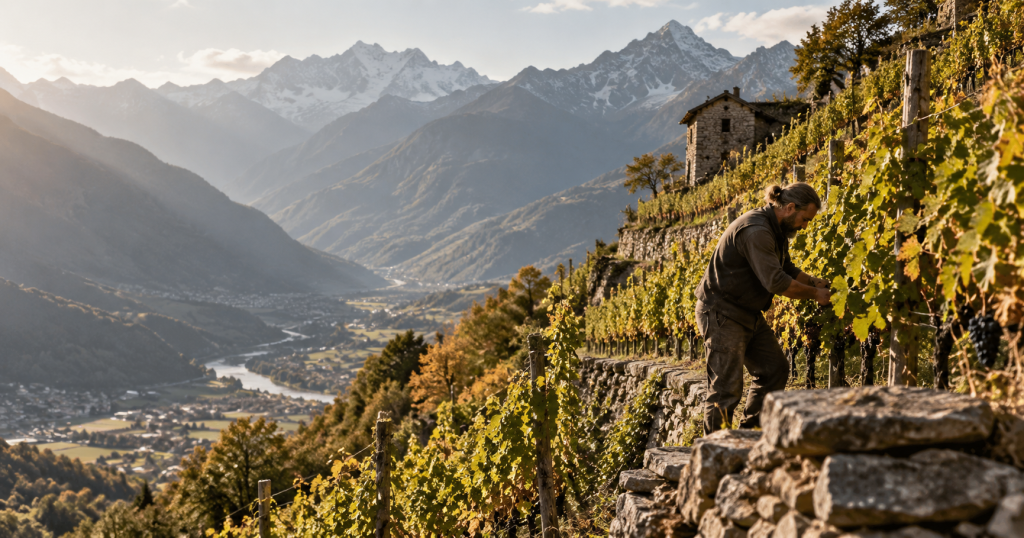
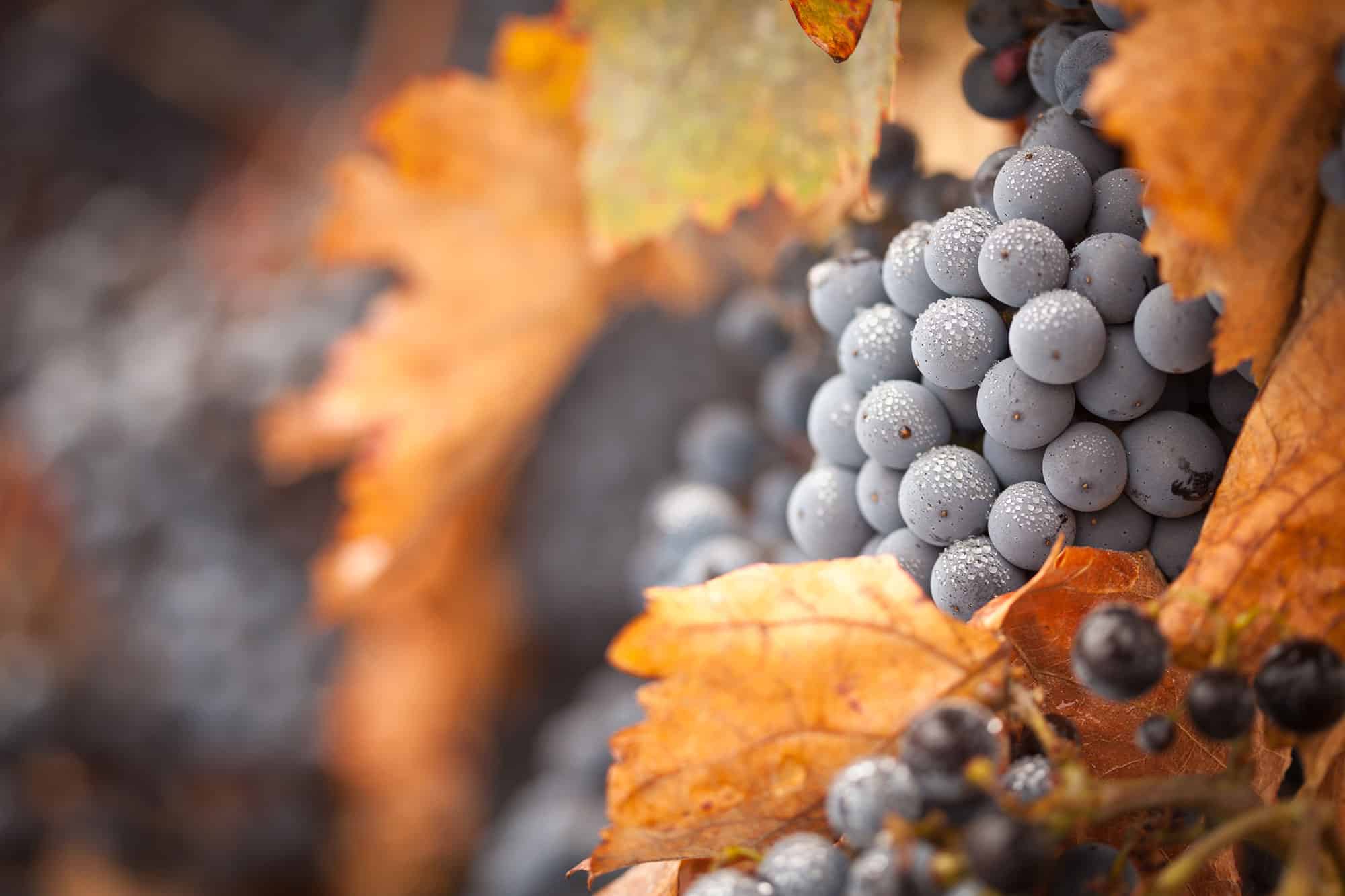
The Ossola production areas enjoy a particularly favourable microclimate: the absence of wind and the warmth coming from the Toce plain have enabled the cultivation of terraced vineyards, from which Prünent and other mountain wines are produced.
A document from the old archive of the convent of San Francesco in Domodossola, discovered by Rosminian Father Don Tullio Bertamini and dating back to 1309, proves that vines have been cultivated since ancient times: this evidence concerns a bequest of approximately 200 litres from a landowner in Masera to the church of San Francesco in Domodossola for the repose of his soul, to be used exclusively during Mass, which had to be entirely Prünent, a clone of Nebbiolo.
The name “Prünent” is Latin and appears to derive from the root “pruina” (frost) or from “prunum” (plum tree, plum): the first case refers to the harvest period (late October – November), during which the land is covered in frost in the morning, while the second is connected to the flavour of the wine or to the tradition of growing vines together with the widely found wild plum trees.
Over the centuries, vines have been one of the most profitable main crops in Ossola thanks to exports to Switzerland, as shown by the old municipal statutes that regulated both the wine trade and the harvest. In the early 1900s, phylloxera began to aggressively attack vineyards throughout Europe, so the old vineyards had to be replanted on American rootstock, losing their local characteristics and planting grape varieties poorly suited to the area.
Another blow to the wine economy came from the increase in customs duties imposed by Valais, which had also begun cultivating its own vineyards. Finally, in the second half of the century, industrial development led winegrowers to leave for industrial jobs. Viticulture was no longer so profitable, and the cultivated area shrank drastically.
In January 1990, the Valle Ossola mountain community and the Catholic University of Piacenza began the restoration of local viticulture: during the initial period, the conditions and potential of the area were assessed. Viticulture is still firmly present in a foothill belt between 200 and 500 metres above sea level, characterised by highly favourable soil and climate conditions, mainly involving the municipalities of Trontano, Masera, Montecrestese, Crevoladossola, Domodossola, Villadossola and Piedimulera, for a total of 50 hectares. One of the main problems is the fragmentation of ownership, while the average age of winegrowers is between 50 and 60, and all producers carry out this activity part-time.
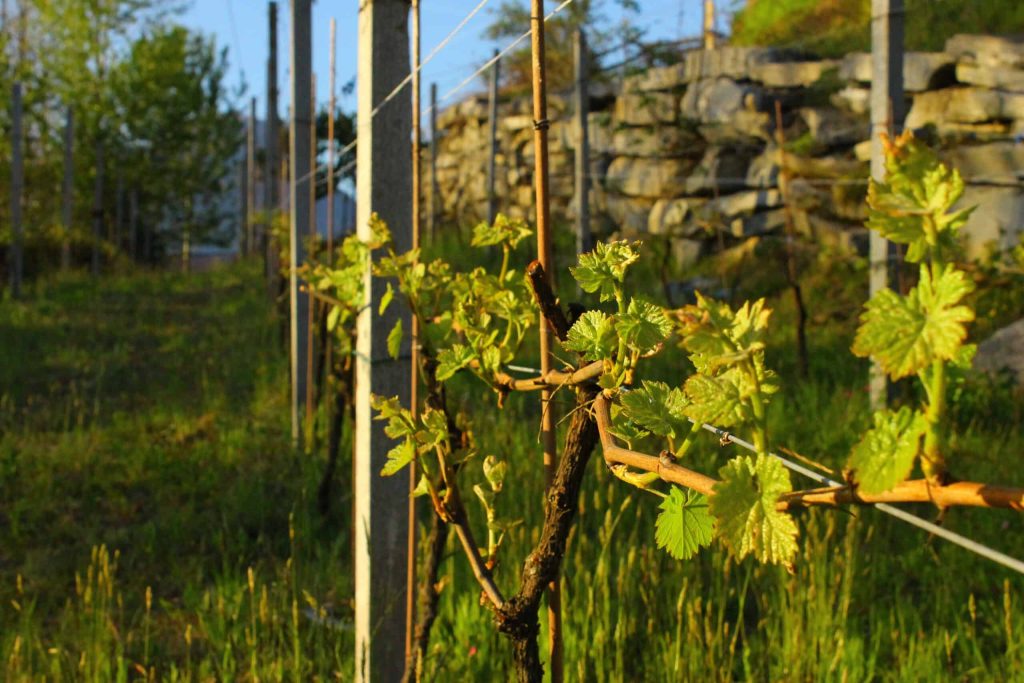
The traditional training system is a type of elongated pergola called “toppia”. The dominant grape varieties are Nebbiolo, Croatina, Merlot and Barbera, but they are always grown alongside other varieties that are not always known; consequently, the vineyards are characterised by extreme heterogeneity, both in terms of varieties and the age of the vines themselves. The grapes are vinified using non-rational methods, and the wine produced is intended exclusively for personal consumption.
In April 1991, three experimental vineyards were planted using a vertical trellis training system (single Guyot) in order to assess grape varieties not yet introduced into the area: Cabernet Sauvignon, Pinot Noir, Gamay, Chardonnay, Pinot Blanc, Pinot Gris, Rhine Riesling, Müller-Thurgau.
These plantings came into production in 1993, allowing an initial assessment of the grape varieties under trial. Alongside the evaluation of these varieties, several rationally planted vineyards using a vertical trellis system were tested, consisting of prized grape varieties already present in the area, particularly various clones of Nebbiolo and Merlot. These plantings came into production in 1995.
In May 1994, thanks to numerous requests from producers, the association of Ossola agricultural producers was established to expand the technical assistance programme, promote the marketing of products and support farmers.
The main wines
Cà d’ Matè
Wine made from grapes grown in Cisore (400 m above sea level in the municipality of Domodossola), Trontano and Masera. The harvest is characterised by a rigorous selection of grapes, so that only healthy, ripe bunches are used for wine production. It is a full-bodied yet harmonious wine, suited to hearty dishes, red meat and cheese, to be served at 16–18°C.
Prünent
Grapes partly sourced from an ancient vineyard in Pello which, according to its owner, already existed at the time of the First World War, and partly from a vineyard in Trontano. Prünent is the typical local wine found in Ossola since the 14th century, bright in colour with strong orange reflections. Its intense aroma is accompanied by an intense, tannic, harmonious and spicy flavour. It pairs well with substantial main courses of meat and game, as well as flavoursome cheeses; serve at 18°C.
Merlot
Produced with grapes from the vineyards of Calice (in the municipality of Domodossola), at an altitude of 380 m above sea level. It has a floral and fruity flavour, blended with spices derived from oak. Serve at 18°C.
Cabernet Sauvignon
Wine made from grapes grown in the vineyards of Preminoira (400 m above sea level) in the municipality of Crevoladossola: it has a bright ruby-red colour and stands out for the aromatic notes of Cabernet grapes and the tannins from the finesse of the wood. It is recommended to uncork the bottle at least one hour before serving it at a temperature of 18–20°C.
Pinot Noir
It is the result of research and experimentation carried out in the vineyards of the municipality of Trontano at an altitude of 500 m above sea level. It is suitable for moderate ageing. Its aromatic, full and slightly acidic flavour is characteristic of the area.
Neuv Bruschett
Wine made from terraced vineyards in the municipalities of Crevoladossola, Masera, Trontano and Montecrestese, it is bright ruby red in colour, with a fresh, vinous aroma and fruity notes typical of local grapes. Harmonious and slightly tannic on the palate, with good structure. It pairs with typical local dishes, is excellent throughout a meal, and should be served at 16°C.
Learn more
To continue your journey through the history and wine of Ossola: the Valli Ossolane DOC, the Prünent grape variety, the figures for local production.